How AI Search Is Changing SEO—and What Nonprofit Marketing Teams Should Do Next
For years, organizations have worked to answer a familiar digital marketing question: How do we get found on Google?
Now there’s another question to consider: How do we make sure people can find accurate, useful information about our organization when they’re searching with tools like ChatGPT, Google AI Mode, or Gemini?
AI-powered search is changing how people discover information online. Rather than scrolling through search results and visiting several websites, people can increasingly ask detailed questions and receive a summarized answer without ever clicking through to a website.
For nonprofit organizations, that shift presents both a challenge and an opportunity.
Traditional search visibility doesn’t necessarily translate into visibility within AI-generated answers. At the same time, many of the practices that make a website useful to its audience also help search engines understand its content.
At Red Orange Studio, our approach to website strategy starts with the people an organization needs to reach. Who are they? What information are they looking for? What do they need to accomplish?
Those questions have guided our work long before AI search entered the conversation. And they’re becoming even more relevant today.

What Is AI Search, and How Is It Different From Traditional Search?
Traditional search engines generally provide a list of websites that might contain the information someone needs. AI-powered search can take that process further by gathering information from multiple sources and presenting an answer directly, often alongside links to supporting websites.
Consider someone searching for youth mental health resources in their community.
A traditional search might return links to nonprofit organizations, government agencies, and resource directories. An AI-powered search experience might instead summarize available programs, describe eligibility requirements, and point the person toward organizations that provide relevant services.
In either case, the quality and clarity of the information available online matter.
Google’s own guidance for AI-powered search confirms that established SEO practices remain relevant to AI Overviews and AI Mode. There are no additional technical requirements or special optimizations needed specifically for these features.
For nonprofit marketing teams, this means thinking beyond whether a page ranks for a particular keyword. It’s also important to consider whether your website clearly communicates what your organization does, who it serves, and how people can access its programs or services.
The goal isn’t to write content for AI instead of people. It’s to make the information people need easier to find, understand, and use.
Start With Your Audience, Not Your Keywords
One of the most important parts of any website project happens before design or development begins.
We work with organizations to understand their audiences, identify their priorities, and determine how information should be organized to support their needs.
For nonprofits, that process can be particularly complex.
A single organization might need its website to serve donors, grant applicants, program participants, volunteers, community partners, and the general public. Each audience arrives with different questions and expectations.
A potential donor may want to understand the organization’s impact. A program participant may need to determine whether they’re eligible for services. A community partner might be looking for resources or opportunities to collaborate.
If the website is organized primarily around internal departments, organizational terminology, or historical content decisions, those visitors may struggle to find what they need.
AI search adds another reason to address those challenges. When important information is scattered across pages, buried in PDFs, or described using language that only internal staff understand, it can be harder for both people and search systems to interpret.
Before developing a new content strategy around AI, consider a few fundamental questions:
- Who are the primary audiences for your website?
- What information does each audience need?
- Are your programs and services described in language those audiences would naturally use?
- Can visitors easily identify the next step they should take?
- Does your website’s navigation reflect audience needs or your internal organizational structure?
These are foundational questions in website strategy and user experience. They’re also a useful starting point for improving how your content can be discovered through search.
Make It Easy to Answer Real Questions
One of the most practical ways to improve website content is to look at the questions your organization already receives.
Think about the emails your staff answers repeatedly, the questions that come up during community events, or the information program participants need before they can take action.
For example, a nonprofit might regularly hear:
- Who qualifies for this program?
- How do I apply for assistance?
- What services are available in my community?
- Where does my donation go?
- How can I volunteer?
If those answers aren’t easy to find on your website, that’s an opportunity to improve the experience.
Sometimes the solution is a dedicated FAQ section. Other times, it’s revising a program page to explain eligibility more clearly, adding a step-by-step application process, or reorganizing resources around common needs.
Answering audience questions doesn’t always mean creating more pages. Often, it means improving the content you already have.
Nonprofit websites naturally grow over time. Programs change, new resources are added, and information is updated by different staff members. Without regular evaluation, that growth can lead to duplicated pages, outdated information, and content that no longer reflects audience priorities.
Before investing in a large volume of new AI-focused content, review your existing pages. Are they accurate? Do they answer meaningful questions? Is the information easy to understand? Could related content be consolidated or organized more effectively?
It’s also worth involving the people within your organization who work directly with your audiences. Program directors understand eligibility requirements. Development teams know what donors ask. Front-line staff hear where people get confused.
That firsthand knowledge is one of your organization’s most valuable content resources. Bringing it into your website can make information more specific, relevant, and trustworthy.
This approach also aligns with Google’s guidance on creating helpful, people-first content, which emphasizes original value and useful information over content created primarily to attract search traffic.
Do Keywords Still Matter for AI Search?
Yes. Keywords still help organizations understand the language people use when looking for information.
But keyword research works best when it’s part of a broader understanding of audience needs.
Consider a nonprofit that provides financial assistance to families. The organization might describe one of its services internally as a “Family Economic Stability Initiative.”
That terminology may be meaningful to staff, funders, and partner organizations. But someone seeking assistance may search for “help paying utility bills” or “financial assistance for families near me.”
Neither description is necessarily wrong. They simply serve different purposes.
A thoughtful content strategy connects the organization’s language with the words its audiences actually use.
That might mean retaining the formal program name while making the page heading, introductory copy, and eligibility information more descriptive and accessible.
Rather than focusing exclusively on a single keyword, consider the broader questions surrounding a topic and the information someone needs to make a decision.
The goal is to create content that clearly explains what your organization offers, who it’s relevant to, and what someone should do next.
Your Website’s Structure Matters as Much as Its Content
Strong content is only part of the equation.
How information is organized, presented, and maintained can significantly affect whether visitors can find and understand it.
At Red Orange, information architecture and user experience are central to our website strategy process. We look at how pages relate to one another, how different audiences move through the site, and whether the navigation helps people reach the information they need.
That work also supports traditional SEO by making content relationships clearer and helping search engines discover and interpret pages.
A few practical areas to evaluate include:
Clear, descriptive headings
Page titles and headings should help visitors quickly understand what information they’ll find. Avoid relying exclusively on clever marketing language when a straightforward description would be more useful.
Specific program and service information
Clearly explain who you serve, what you provide, where services are available, and what someone should do next. Important details shouldn’t require visitors to navigate through several unrelated pages.
Connected content
Use internal links to help people move between related programs, resources, eligibility information, and next steps.
Accurate, current information
Outdated program descriptions, incorrect contact information, and expired eligibility requirements can create confusion and undermine trust.
Appropriate structured data
Schema markup can provide search engines with additional context about your organization and certain types of content, including articles and events. It can support eligibility for certain search features, but Google does not require special AI-specific schema to appear in AI Overviews or AI Mode.
These are established practices that support website usability and traditional search optimization. While they also provide a sensible foundation as AI search evolves, no single structural improvement guarantees that a website will be included or cited in an AI-generated answer.
Ultimately, the goal is to make your website easier for people to navigate, understand, and use.
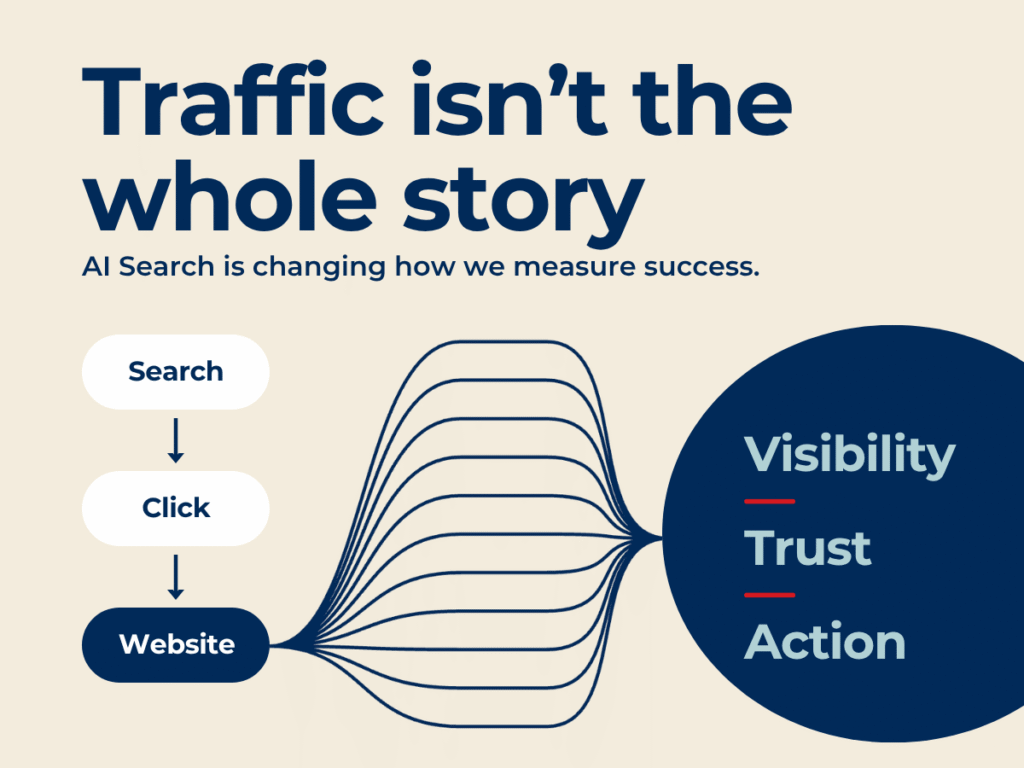
What Happens When Website Traffic Isn’t the Whole Story?
One of the more significant implications of AI-powered search is that people may learn about an organization without immediately visiting its website.
If an AI-generated answer provides the information someone needs, that person may not click through to the original source.
There’s evidence that this is already affecting search behavior.
A 2025 Pew Research Center study found that Google users clicked on a traditional search result in just 8% of visits to search pages containing an AI summary, compared with 15% of visits to pages without one. Only 1% of visits to pages with an AI summary resulted in a click on a link within the summary itself.
Those findings don’t mean every nonprofit should expect a corresponding decline in traffic. But they do illustrate why traditional website visits may tell an increasingly incomplete story about online visibility.
Organic sessions and search rankings still matter. Nonprofit marketing teams should evaluate those metrics alongside outcomes that reflect their organizational goals.
Depending on the organization, those might include:
- Qualified inquiries or contact form submissions
- Donations
- Program applications
- Volunteer registrations
- Event sign-ups
- Resource downloads
There are also opportunities to monitor visibility within AI-powered search itself.
Google’s Generative AI performance report in Search Console provides impression data for supported AI search features, including AI Overviews and AI Mode. Organizations can use these insights to understand which pages are appearing in those experiences.
Referral traffic from tools like ChatGPT may provide another useful signal, although it won’t capture every instance in which someone encounters information about your organization through AI.
It’s important not to assume that every change in organic traffic is caused by AI search. Search behavior, competition, seasonal trends, and technical issues can all affect performance.
The bigger point is that traffic has never been the ultimate goal for most nonprofit websites.
A website exists to support the organization’s mission. Whether that means connecting someone with assistance, encouraging a donation, or helping a community partner access resources, meaningful actions matter more than visitor counts alone.
Five Ways to Prepare Your Website for AI Search
Preparing for AI search doesn’t require abandoning your existing SEO strategy or rebuilding your website around a new technology.
For most nonprofit organizations, the best next step is to strengthen the fundamentals while paying closer attention to how people find and use information.

1. Protect the fundamentals
Keep your website technically healthy, accessible, mobile-friendly, and easy for search engines to crawl. Confirm that important pages are indexable and that relevant search crawlers aren’t unintentionally blocked.
2. Understand your audience’s real questions
Talk with staff, review common inquiries, and identify the information people need before they can take action.
3. Share real expertise
Use your organization’s firsthand knowledge to explain programs, answer complicated questions, and provide context that isn’t readily available elsewhere.
4. Make content easy to understand
Use descriptive headings, clear language, logical page structures, and thoughtful internal links.
5. Measure what matters
Monitor traditional search performance, emerging AI search visibility, and meaningful organizational outcomes, from applications and donations to registrations and inquiries.
These aren’t shortcuts to appearing in AI-generated answers. They’re practical improvements that support a stronger website and a more useful experience for the people you serve.
The Bottom Line: Build a Better Website for People
AI search is changing how people discover information, but the fundamentals of a successful website haven’t changed. Organizations still need to understand their audiences, communicate clearly, and make it easy for visitors to take meaningful action.
At Red Orange Studio, that’s where our website strategy begins. Rather than chasing every new search trend, we focus on building thoughtful digital experiences that connect organizations with the people they serve.
As search continues to evolve, that foundation matters more than ever.
Not sure where your website stands?
Red Orange Studio can help evaluate your website’s technical SEO, content organization, and opportunities for improved search visibility. Together, we can identify practical improvements that make your website more useful to the people you’re trying to reach.